Our name is our method
Mimamsa means inquiry, reflection, investigation, reasoned examination. We chose it because it names the one thing we care about most: teaching children to examine the world for themselves, rather than accept it secondhand. Our fuller name, Mimamsa Thought Labs, captures the spirit of a session; a space to experiment with ideas.
What we do
Under Project Mimamsa, children from rural and economically weaker backgrounds learn how to think and how to build their own understanding of the world. We run a structured, multi-year program that grows a specific set of capacities, observation, reasoning, critical reading, experimentation, and independent problem-solving, in children who are too often handed only a syllabus to memorise.
Why this work matters
The capacity to think for oneself is natural to every child, but the opportunity to develop it is not.
Two children can be equally capable. One grows up with teachers who nurture curiosity, books to explore, and adults who ask “why do you think that?” The other is handed a textbook to memorise and told only to remember it. The difference in who they become is not a difference in ability. It is a difference in circumstance and that is precisely what makes it unfair. Mimamsa exists to close that gap by teaching children in Grades 6 to 8 not what to think, but how to think.
A documented crisis, not a hunch. The problem Mimamsa addresses is recognised at every level. India’s National Education Policy 2020 explicitly calls for moving assessment away from rote memorisation toward higher-order skills such as analysis, critical thinking, and conceptual clarity. The need is urgent: the World Bank and UNESCO estimate that around 70% of ten-year-olds in low- and middle-income countries cannot read and understand a short, age-appropriate text. A syllabus built for memorisation is not producing understanding.
The burden falls on the poor. This is not an equal-opportunity failure. Using international assessment data, Mitani (2021) documents wide gaps in higher-order thinking skills between the lowest- and highest-income students, gaps driven not by talent but by unequal access to the kind of teaching that develops reasoning. Such skill inequalities open early and persist through schooling (García & Weiss, 2017). Research shows that students from low-socio economic families have fewer opportunities to Higher Order Thinking activities (e.g., Kalil, 2015; Kalil et al., 2016; Lareau, 2003; Phillips, 2011). The children least likely to be taught how to think are exactly those Mimamsa serves.
Why thinking is the advantage that lasts. Teaching children to reason is not a luxury layered on top of “real” education. Leading scholarship argues it is the proper aim of education itself. Deanna Kuhn’s work on 8-to-13-year-olds makes the case that inquiry and argument belong at the centre of the curriculum, developing the skills and dispositions needed for lifelong learning (Kuhn, 2005). It is also an idea rooted in John Dewey’s insistence that reflective thinking, not passive absorption, is what schooling is for (Dewey, 1916). The U.S. National Research Council’s consensus report frames these capacities as “deeper learning”: knowledge and skills that transfer to new and unfamiliar situations (National Research Council, 2012). And the payoff is concrete. Critical thinking predicts fewer negative life outcomes in health, finance, and relationships, and does so better than intelligence (Butler, 2012; Butler et al., 2017).
It matters beyond the individual. The economy increasingly rewards these skills: analytical thinking is the most sought-after competency among employers worldwide (World Economic Forum, 2025), even as only around half of India’s graduates are judged employable, with rote-heavy curricula repeatedly blamed (Wheebox, 2025). At the level of nations, the cognitive skills of a population, not years of schooling alone, drive long-run economic growth (Hanushek & Woessmann, 2015). A democracy, too, needs citizens who can weigh a claim and recognise misinformation. This skill is in short supply, given that most middle-schoolers cannot tell a news story from an advertisement (Wineburg et al., 2016).
The good news: this can be taught. Inquiry-based learning works. Meta-analyses find large gains in conceptual understanding when children learn through guided inquiry rather than memorisation (Mediana, Funa & Dio, 2025), and decades of evidence show that active, questioning-based learning outperforms passive lecture (Freeman et al., 2014).
The capacity to think is the one gift poverty cannot take away and the one that keeps giving itself back. Mimamsa’s work is to make sure it reaches every child, not only those who can afford it.
What we want for every child
Our objectives are to develop, in children from under-resourced communities, both the capacities and the disposition to:
- Observe, stay curious, experiment, and be rigorous: (Observation, Curiosity, Experimentation, Rigour)
- Build their own understanding of what they see and experience: (Theory Construction)
- Understand subjects deeply: science, mathematics, and the social sciences (Deep Understanding)
- Examine what they read and hear critically: (Critical Thinking)
- Solve problems and make decisions using the concepts they’ve understood: (Problem Solving, Decision Making)
- Bring reasoning to bear on emotion, to give more coherence to how they act.
Where we come from
Mimamsa is a project under Swabhaan Foundation.
Swabhaan Foundation is a registered as a section 8, Not -for -profit company based in Pune.
CIN – U88900PN2026NPL255159
We are currently working –
- In person with students from 5 afterschool community centres located in Pune, Maharashtra – Laxminagar, Timber Market, Ganj Peth, Ambegaon, and 1 low income aided marathi medium school.
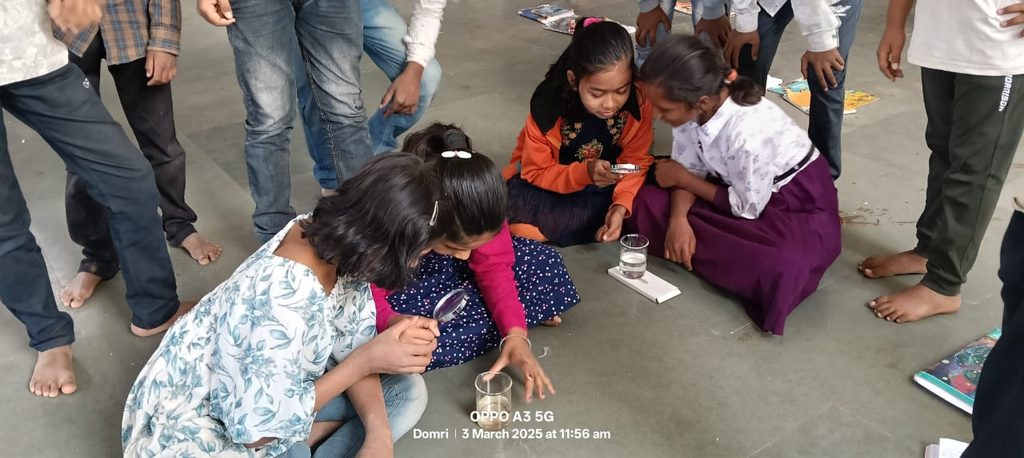
- In person with teachers and students from Sondara Gurukul located in a small village called Domri in Beed district of Maharashtra
- In hybrid mode ( Offline + Online) in two villages in Murbad Taluka of Thane district.