Project Mimamsa Thought Labs
We teach children not what to think, but how to think, because the capacity to think for oneself is the one resource that has the great potential to change lives and one that poverty cannot take away.
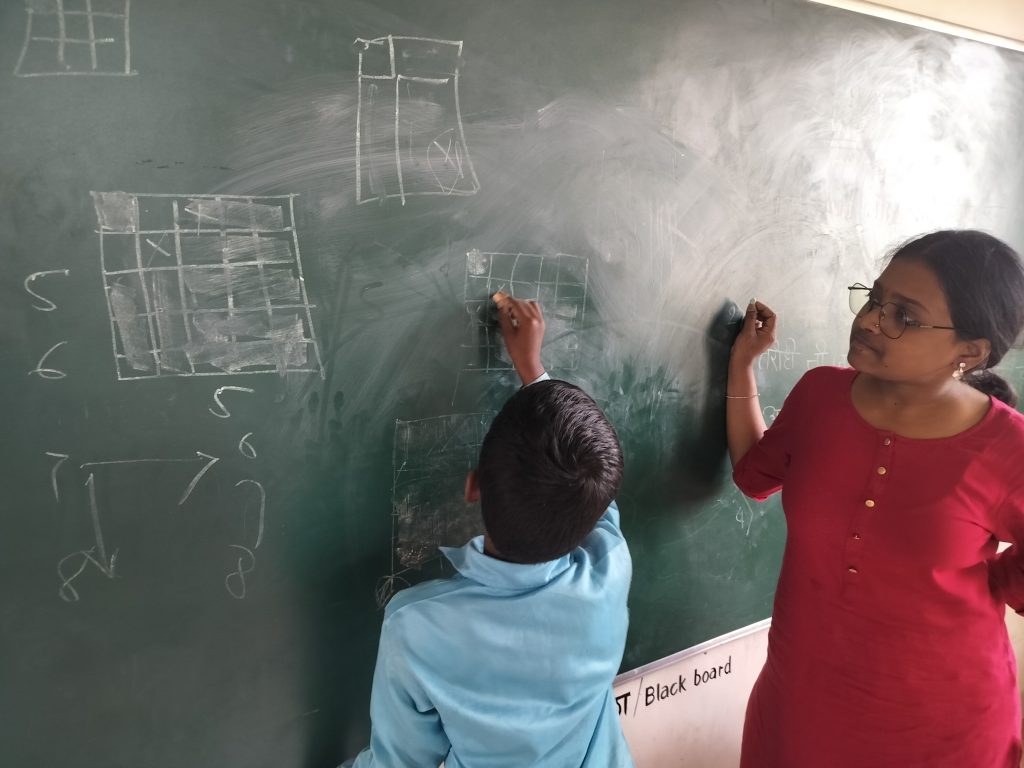
@ Khelghar, the afterschool centre in Laxminagar Slums.
[Support a Thinker → ] [See How It Works → ]
What is Mimamsa?
Mīmāṃsā, is a Samskrit word for ‘reflection, consideration, profound thought, investigation, examination, discussion’
(NOT to be confused with ‘the school of Hindu philosophy, entirely built upon believing in the absolute, infallible authority of the word of the Veda’ in fact, quite the OPPOSITE), .
A Mimamsa session doesn’t begin with an answer to memorise. It begins with a question or a puzzle: how does a pen actually write? how do we decide if something is good or bad? is this news item true? what does it mean to be ‘successful’? is there a pattern behind how these numbers change? how does this card trick work? why does the amplitude of sound change depending on where we hold a glass under a tap? Why is it so difficult to unite people?
Children reason out loud, disagree, test their ideas, and change their minds. A facilitator guides, but doesn’t hand over the answer. Over the three years, children develop the abilities to observe, experiment, question and think for themselves. Our work builds on the inquiry framework created by Dr. K P Mohanan and Dr. Tara Mohanan. Please refer to www.thinq.education for details.
We work with children in Grades 6 to 8 from rural and low-income communities across Maharashtra – in Pune, Domri – Beed, Wada – Palghar, and Murbad – Thane.
The problem we’re working on
Every child is born able to wonder, question, and reason. What differs between children is not that capacity but the chance to develop it. One child grows up surrounded by adults who feed curiosity; another is handed a syllabus to memorise and told only to remember it. That is not a gap in ability, it is a gap in circumstance, and that is what makes it unjust.
The problem is well documented. India’s own National Education Policy 2020 calls for a decisive shift away from rote memorisation toward analysis, critical thinking, and conceptual clarity. It is an admission, at the highest level, that the current system falls short. The deficit falls hardest on the poor. Large-scale international data show wide gaps in higher-order thinking skills between the lowest- and highest-income students (Mitani, 2021), driven not by talent but by unequal access to teaching that builds reasoning.
This matters because the ability to reason is the advantage that lasts. Critical thinking predicts better real-world decisions across health, finance, and relationships, more strongly, in fact, than intelligence does (Butler et al., 2017).
It is the single most sought-after skill among employers worldwide (World Economic Forum, 2025), and, at the level of nations, the cognitive skills of a population drive long-run prosperity (Hanushek & Woessmann, 2015).
Mimamsa exists to put that advantage within reach of children who would otherwise be denied it by teaching them not what to think, but how.
What we do, briefly
- Run a three-year inquiry program for children in Grades 6–8, built around 12 themes that develop reasoning, observation, and independent thought.
- Work directly in communities: in slums, villages, and schools serving low-income families.
- Deliver in person and through hybrid (online + in-person) sessions, so distance doesn’t decide who gets to take part.
- Partner with schools, centres, and NGOs already working with children who need this most.
[Learn more about our Programs →]
What changes in a child
After a single year in the program, facilitators consistently see children who:
- observe more closely, using all their senses
- ask more questions, and ask them more precisely
- have the confidence to raise a question at all
- design sharper little experiments to test an idea
- spot patterns and notice inconsistencies
- approach a problem from several angles at once
- understand concepts, especially in science far more deeply
These aren’t exam results. They’re habits of mind, and they last.
[View Testimonials →] [Read our reports →]
Find your way in
Parents: See what your child actually does in a Mimamsa session, and how the same thinking can grow at home. [What is Inquiry →]
Teachers: Explore the method and the 12 themes, and bring inquiry into your own classroom. [Programs →] · [Resources →]
Schools & after school centres: Bring the three-year program to your students through a partnership. [Programs →]
Donors & supporters — Your support keeps children reasoning, questioning, and thinking for themselves. Here’s exactly how to help. [Get Involved →]
Closing call to action
The capacity to think is the one gift that keeps giving itself back.
Help us put it within reach of more children.